Avoid Free-plan AWS accounts, even if you're a beginner to cloud
1108 words (~7 mins read)
Although in 2025 AWS introduced the concept of Free-plan AWS accounts for new customers, in this blog post I want to make a case for using Paid-plan AWS accounts even if you are a beginner. This might be a controversial take since tons of people have asked AWS for years to implement a free playground/sandbox environment to learn AWS, and yet once they finally did, here I am now to tell you to jump straight to paid accounts. 😅
Free-plan AWS accounts
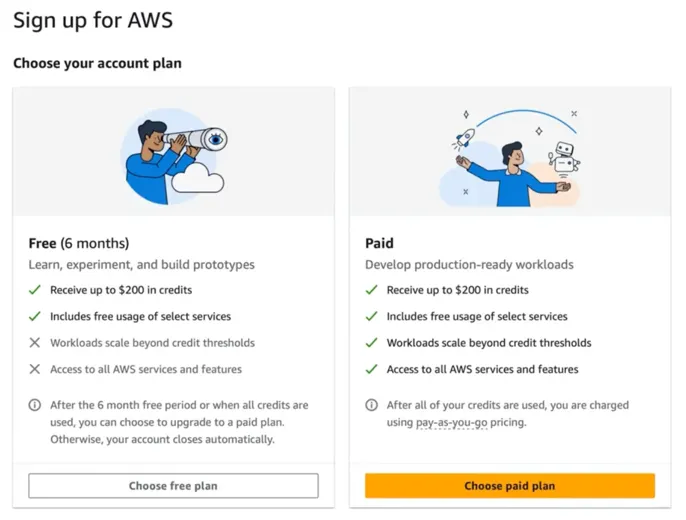
Historically, there were no Free- or Paid-plan AWS accounts. There were free tiers in AWS services, some of which had free usage for 12 months. Since 2025, AWS offers Free-plan accounts to brand new AWS customers: https://aws.amazon.com/free/ . In essence, Free-plan accounts won't bill you during the first 6 months, and you get up to $200 of usage in AWS credits. However, once the 6 months or your credit usage is up, your workload will stop until you upgrade to the paid plan! Additionally, not all AWS services and features are available in Free-plan accounts.
Only ONE Free-plan AWS account per new customer!
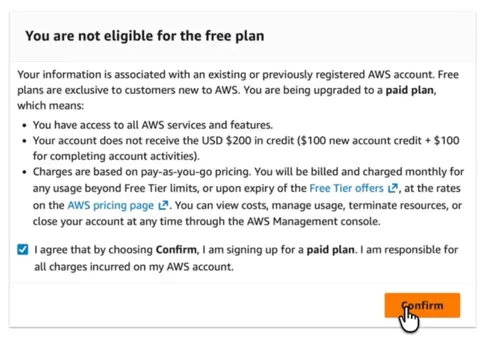
Although you can have as many Paid-plan AWS accounts as you wish, a new customer can only use one Free-plan account once, and never again! In order to enforce this, AWS thoroughly checks your customer credentials (name, credit card, your billing address, your email...) and makes sure they haven't been used in any other AWS account before, otherwise you won't be eligible to open a Free-plan AWS account. Even if your previously used AWS account is inactive or has been closed long ago, AWS still keeps historical data of those accounts and this can prevent you from opening a Free-plan AWS account. Notoriously, you can use sub-addressing or mail extensions for creating different Paid-plan accounts, but NOT for creating different Free-plan accounts. For example, user+awsaccount1@gmail and user+awsaccount2@gmail both direct to user@gmail.com, and you can create two different Paid-plan accounts with those two email addresses, but you can't create two different Free-plan accounts.
AWS Free vs Paid
Not all AWS services and features are available in Free-plan accounts, and your workload will be stopped if you exceed your credits or the 6-month limit. But at least you get the benefits of free usage, right? Wrong! Paid-plan accounts can ALSO benefit from up to $200 in credits, as well as the free usage of select services. Some AWS services offer free trials, others a free usage quota every month, and some are free indefinitely. And this is the same REGARDLESS of whether you use a Free-plan or a Paid-plan account. The only difference is that if you exceed your quotas, AWS will simply stop your workloads, instead of billing you while they continue to run. And if it's about privacy, you still need to give your credit card details if opening a Free-plan account, even if you don't pay anything! So, I don't think the advantages are really there!
Learning AWS costs
Monitoring costs of your cloud resources, setting alerts, and managing budgets are essential skills for a cloud engineer. The sooner you learn them, the better. Any high quality online course or blog for learning AWS/cloud should teach you the good habit of setting budgets and alerts, as well as the good habit of tearing down your infrastructure the moment you don't need it anymore. If the course you're following did not teach you this in the beginning, you know it's NOT of good quality! Letting AWS or other platforms create the guardrails for you is giving you the fish today instead of teaching you how to fish.
Be responsible! You should be OK with the idea of spending a bit of money learning AWS. You are, after all, running resources on someone else's hardware. That's NOT free! Learn to be mindful of your infrastructure: spinning resources up and then forgetting about them is a terrible habit. Most of us have had nasty bill shocks from stuff we didn't know was billing us. You'd rather that be a couple of bucks while learning AWS than thousands of dollars in your company's production environment! Choose to learn the hard lessons earlier rather than later. Googling “EC2 billing” or "S3 pricing", reading the docs, and understanding how you will get billed should become second nature to you if you intend to use AWS/cloud seriously. You should also learn how using multiple accounts over a single monolithic account to host a complex cloud system is usually the way to go (can't learn that in a single Free-plan account).
Bikes with training wheels are detrimental for learning
As an analogy to all that I'm advocating for, think about bikes with training wheels versus plain balance bikes. I used bikes with training wheels as a child because balance bikes scared me and I just wanted to enjoy riding my bike. I did not understand that I was learning bad habits and stunting my progress. I did not ride much as a child or as a teenager, and I did not venture into normal bikes until I was fourteen years old! And yes, even at that age, I still had to fall off from normal bikes a few times until I learned how to keep my balance. It would have certainly been better for me to learn to ride a bike properly when I was a young child!

When might a Free-plan AWS account make sense?
I can personally recommend a Free-plan account in a niche scenario: if you are a student with plenty of free time for the next 6 months, and you want to explore AWS to get a feel for it, then maybe you could go for a Free-plan account. I assume you're not too serious about learning cloud, and you can dedicate quite a bit of time to play here and there during those 6 months. However, if you're for example aiming to get certified in AWS, even if it's just the Cloud Practitioner certification, I definitely will advocate that you train on a Paid-plan account. You won't feel the 6-month time limit pressure, you will learn best practices on billing, and overall just be better prepared for the real world.
Conclusion
There are not many reasons why you should delay learning to monitor costs and budgets if you're serious about learning AWS. Plus, tons of people learned AWS before Free-plan accounts started to exist in 2025. You certainly don't need a Free-plan account to learn AWS, and it can even be detrimental to use one. Learning good habits and foundations in the beginning will save you lots of trouble later down the line.